
The short answer
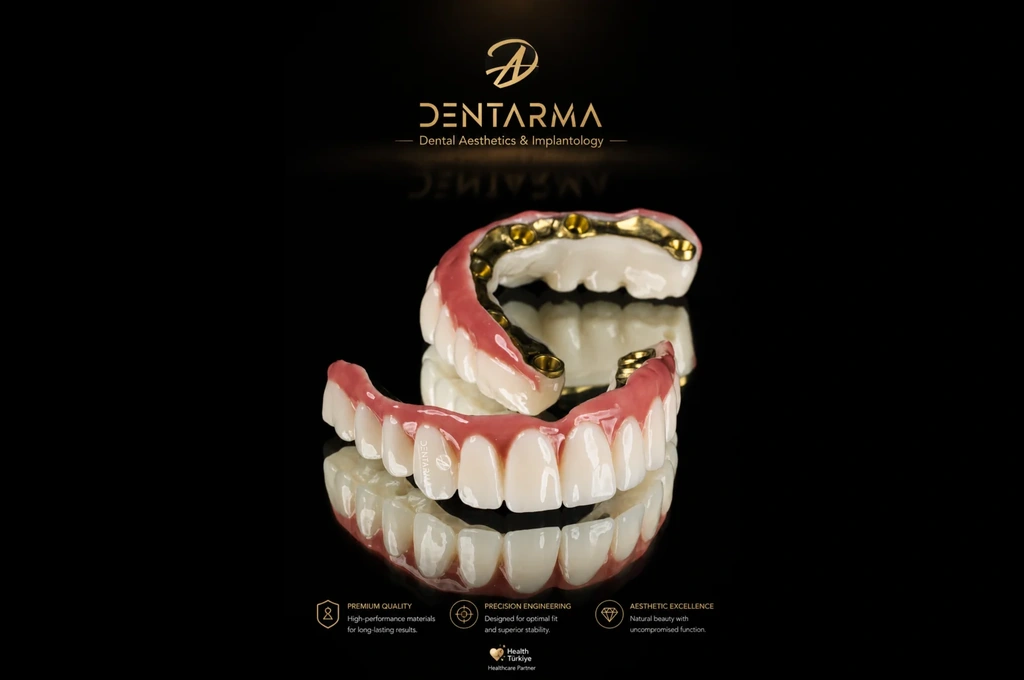
All-on-4 replaces a full arch of teeth with a fixed bridge on four implants, two upright at the front and two tilted at the back, which often avoids bone grafting. In Turkey, including Antalya, published 2026 price guides put All-on-4 at roughly £2,100 to £7,200 per arch (≈ €2,500 to €8,450); the spread comes mostly from the final bridge material, the implant brand and what the quote leaves out. At DentArma it starts from £3,400 per arch or £6,000 for both arches, with Neodent implants, a final zirconia bridge, and hotel and VIP transfers for both visits. Treatment takes two trips of about a week each, 3 to 6 months apart, with fixed temporary teeth in between. For most patients, All-on-4 and All-on-6 perform comparably; All-on-6 earns its extra cost mainly for heavy grinders, smokers and soft bone.
All-on-4 in Antalya: the essentials
- Four implants per arch, the back two tilted to use denser bone, which often avoids a sinus lift or bone graft.
- From £3,400 per arch at DentArma, or £6,000 for both arches, including the final zirconia bridge, hotel and transfers for both visits.
- Two trips of about a week each, 3 to 6 months apart. In most cases fixed temporary teeth are fitted on the day of surgery, so you're not left without teeth.
- All-on-4 vs All-on-6: no significant difference in implant survival in head-to-head trials; the right choice comes from your 3D scan, not a price list.
- Safe when it's planned and documented: 3D CBCT planning, a named implant brand with batch numbers, gum health checked first, and everything in writing.
- At DentArma: planned by two university professors, an Implant Passport with LOT and REF numbers, a lifetime manufacturer implant guarantee, a 5-year bridge warranty, and UK aftercare in Surrey, South Croydon and Glasgow.
What is All-on-4 dental implant treatment?
All-on-4 is a way of replacing every tooth in one jaw (upper, lower, or both) with a single fixed bridge supported by four dental implants. It was developed by the Portuguese dentist Paulo Maló with Nobel Biocare in the late 1990s, and it is now one of the most widely used full-arch implant treatments in the world. The bridge is screwed to the implants: you don’t take it out, it doesn’t cover the roof of your mouth, and it doesn’t slip.
It suits people who have already lost most of their teeth in a jaw, whose remaining teeth are failing, or who wear dentures they no longer want. A typical All-on-4 bridge carries 10 to 12 teeth per arch.
Why are the back implants tilted?
When teeth are lost, the jawbone at the back shrinks first. In the upper jaw the sinus sits just above it; in the lower jaw a nerve runs through it. Placing upright implants there often means a bone graft or sinus lift first: more surgery, more cost and months of extra waiting. All-on-4 tilts the two back implants forwards (up to about 45°) so they anchor in denser bone further forward, avoid the sinus and the nerve, and still support teeth towards the back of the mouth. Whether this works for you depends on your bone, which only a 3D CBCT scan can show.
Why two All-on-4 quotes in Antalya are rarely for the same thing
Here is what most All-on-4 pages leave out. “All-on-4” tells you how many implants go in each jaw and nothing else. It doesn’t say which implant brand, whether the price is per jaw or for both, whether the final bridge is included, what it’s made of, or whether your second trip is covered. Two quotes with the same name can differ by thousands of pounds and both be honest, because they describe different treatments.
That’s why the cheapest headline price is a weak way to compare. The useful question is what each line of the quote actually buys.
The All-on-4 quote decoder: 8 lines to check on any quote
| On the quote | Why quotes differ | What to ask for in writing |
|---|---|---|
| Price basis | Some quotes are per arch, some for both jaws. A per-arch price can look half the cost of a full-mouth one. | "Is this per arch or for both upper and lower?" |
| Implant brand | Premium, mid-range and unbranded systems all appear under "premium implants". Unnamed systems may be impossible to service at home. | The brand and system by name, with LOT and REF numbers recorded in an implant passport. |
| Temporary teeth | Fixed temporary bridges are standard on the first trip; some low quotes price only this stage. | "Is the temporary bridge fixed, and when is it fitted?" |
| Final bridge | Often quoted separately. An acrylic bridge and a zirconia bridge can change the total by a four-figure sum. | "Is the final bridge included, and what material is it?" |
| Scan, extractions, medication | The 3D CBCT scan, extractions and medication are included by some clinics and billed separately by others. | "Are the scan, extractions and medication in this price?" |
| Bone graft or sinus lift | Only known after a 3D scan, and the most common reason a final bill differs from the first quote. | "What could change after the scan and by how much?" |
| Second visit | Hotel and transfers for the final-bridge trip, 3 to 6 months later, are often left out. | "Are hotel and transfers covered for both visits?" |
| Guarantees | Verbal promises, or a guarantee on the implant but not the bridge. | What is guaranteed, by whom, and for how long, in writing. |
Compare quotes line by line. A quote that can’t answer all eight isn’t comparable with one that can.
Ask every clinic: "Will you send me a fixed written quote naming the implant brand, the number of implants per arch, the final bridge material, everything included across both visits, and what's guaranteed, before I book anything?" A clinic planning your treatment answers it line by line.
How much does All-on-4 cost in Antalya?
Published 2026 price guides put All-on-4 in Turkey, including Antalya, at roughly £2,100 to £7,200 per arch (≈ €2,500 to €8,450 / $2,900 to $9,700). The low end usually means an acrylic bridge and a value implant system; the high end, premium Swiss or Swedish implants and a full zirconia bridge.
At DentArma in Antalya, All-on-4 is priced as an all-inclusive package. You get an indicative quote from your X-ray before you travel, finalised in writing after your 3D scan and before any treatment:
| DentArma All-on-4 | GBP | USD (≈) | EUR (≈) | CAD (≈) | AUD (≈) |
|---|---|---|---|---|---|
| One arch (upper or lower) | from £3,400 | $4,570 | €3,970 | C$6,410 | A$6,530 |
| Both arches (full mouth) | from £6,000 | $8,070 | €7,000 | C$11,320 | A$11,520 |
“From” prices with Neodent implants (Straumann Group) and a final zirconia bridge. Straumann and Nobel Biocare implants are priced higher. Approximate mid-market conversions; your quote is fixed in writing, so exchange-rate movements don’t change it after booking.
What's included in DentArma's All-on-4 price?
- Consultation and 3D CBCT scan, with your plan reviewed by two university professors.
- Extraction of remaining teeth in the treated arch.
- Four implants per arch with an Implant Passport recording brand, model, LOT and REF numbers.
- A fixed temporary bridge, usually fitted on the day of surgery.
- The final zirconia bridge (Dental Direkt) fitted on your second visit, with a Crown Certificate.
- Hotel accommodation and VIP transfers for both visits, plus medication and post-operative checks.
- A lifetime manufacturer implant guarantee and a 5-year written bridge warranty.
Not included: flights, and a bone graft or sinus lift if your scan shows you need one, which is priced in your written quote before any treatment. For the treatment itself, see our All-on-4 treatment page; for full-mouth detail, see our guide to full mouth dental treatment in Turkey.
Why does All-on-4 cost less in Antalya?
For structural reasons: lower clinic operating costs, laboratory fees, staff costs and rents. The implants themselves are not different: Straumann, Nobel Biocare and Neodent systems are the same products used in private practice in the UK, Europe, North America and Australia. That’s also why a dramatically cheaper quote deserves a closer look: if every other line is the same, the saving usually comes from the implant brand or the final bridge.
All-on-4 vs All-on-6 dental implants in Antalya: which is better?
For most patients, neither is clearly better. A 2026 review of the evidence, including two head-to-head randomised trials, found no significant difference in implant survival between four and six implants over three to five years. The differences that matter are about your bone, your bite and your habits:
| Factor | All-on-4 | All-on-6 |
|---|---|---|
| Implants per arch | 4: two upright at the front, two tilted at the back | 6 spread along the arch, usually upright |
| Bone needed | Less: tilted back implants often avoid a graft or sinus lift | More along the arch; grafting is needed more often |
| Implant survival in head-to-head trials | 98.75 to 100% (3 to 5 years) | 95 to 99.4% (3 to 5 years), no significant difference |
| Load and repairs | More load per implant | Load spread wider; some analyses suggest fewer technical complications |
| Cleaning | Fewer implants to clean around | More implants to keep clean |
| Often the better fit for | Standard-risk patients and reduced bone at the back of the jaw | Heavy grinders, smokers, soft bone, or a long bridge extension behind the last implant |
| DentArma price, per arch | from £3,400 | from £4,200 |
| DentArma price, both arches | from £6,000 | from £7,800 |
| Trips to Antalya | Two | Two |
Survival figures from a narrative review published in the Danish Dental Journal (Tandlægebladet), August 2026. Evidence beyond ten years is limited for both concepts.
When is All-on-6 worth the extra cost?
When your scan shows enough bone along the arch and something raises the load on each implant: heavy grinding or clenching, smoking, soft bone, or a bite that would need a long bridge extension behind the last implant. In those cases two extra implants share the load. When bone at the back is limited, All-on-4’s tilted implants are often the way to avoid grafting altogether. At DentArma, the professors recommend from your CBCT scan, and if both options suit your bone, you get a fixed written quote for each. For more depth, see All-on-6 dental implants in Turkey.
How does All-on-4 dental implant treatment work in Antalya?
All-on-4 takes two trips to Antalya of about a week each, with three to six months of healing at home in between. In most cases you have fixed teeth throughout. A typical sequence at DentArma:
| Stage | What happens |
|---|---|
| Before you travel | Free remote assessment from a panoramic X-ray or photos; indicative plan and written quote |
| Visit 1 · Day 1 | Examination and 3D CBCT scan; the professors confirm the plan, the implant positions and the number of implants, and your quote is finalised in writing before any treatment |
| Visit 1 · Day 2 | Extractions where needed, four implants placed under local anaesthesia, fixed temporary bridge usually fitted the same day |
| Visit 1 · Days 3 to 7 | Rest, check-ups and adjustments; you fly home with fixed temporary teeth |
| At home · 3 to 6 months | The implants fuse with the bone; soft diet at first, then gradually more normal eating; WhatsApp contact with the clinic throughout |
| Visit 2 · about a week | Scans and a try-in, then the final zirconia bridge is fitted; Implant Passport and Crown Certificate issued |
Indicative schedule; exact timing depends on your case. Total treatment time is usually four to seven months.
How long do I need to stay in Antalya?
About a week for each visit. The first visit needs the most days, because the surgery and the temporary bridge come first and the team checks your healing before you fly. If the scan shows a graft or sinus lift is needed, the plan and sometimes the healing time changes, and you’ll know before treatment starts.
Does All-on-4 treatment hurt?
The surgery is done under local anaesthesia, so you shouldn’t feel pain during it. Afterwards, swelling and discomfort are normal for the first few days and are managed with prescribed medication. Most patients rest for a day or two, then spend the remaining days of the first trip recovering in Antalya on a soft diet.
Are All-on-4 dental implants in Antalya safe? The 8 checks
All-on-4 is an established treatment with long-term clinical data. It is as safe in Antalya as anywhere else when the clinic plans properly, documents what it places, and puts everything in writing. No official ranking of Turkish clinics exists, so run these eight checks on any clinic on your shortlist, including DentArma.
| What to check | Possible risk if not checked | The DentArma answer |
|---|---|---|
| 1. 3D planning before surgery | Implants placed without knowing bone volume or where the sinus and nerve sit, raising the risk of failure and nerve injury. | ✓ A 3D CBCT scan on every case, with implant positions planned before surgery. |
| 2. Implant brand, named and documented | Unnamed or copy implants that no dentist at home can identify, service or replace parts for. | ✓ Straumann, Nobel Biocare, Neodent, Osstem, S.I.N., recorded with LOT and REF numbers in an Implant Passport. |
| 3. Four or six decided by your scan | An implant count set by a package tier rather than your bone and bite. | ✓ The professors recommend from your CBCT; if both suit you, you get a written quote for each. |
| 4. Gum health and history | A history of gum disease markedly raises the risk of peri-implantitis, inflammation that can cost implants years later. | ✓ A professor of periodontology assesses gum health and history, with a cleaning plan for life after treatment. |
| 5. Who plans the case | Full-arch surgery delegated to whichever clinician is available. | ✓ Every case planned and reviewed by two university professors. |
| 6. Final bridge in writing | A price that covers only the temporary teeth, with the final bridge charged later or made from acrylic. | ✓ The final zirconia bridge is in the written quote, recorded in a Crown Certificate. |
| 7. Healing time respected | A final bridge fitted before the implants have fused with the bone. | ✓ 3 to 6 months of healing, with the final bridge fitted only after the implants are checked. |
| 8. Guarantees and care at home | Verbal guarantees, and nobody to see once you're home. | ✓ Lifetime manufacturer implant guarantee, 5-year written bridge warranty, UK aftercare in Surrey, South Croydon and Glasgow; authorised by the Turkish Ministry of Health. |
What are the risks of All-on-4?
The risks are those of any implant surgery. In the short term: infection, swelling and bruising, or an implant that doesn’t fuse with the bone, more likely in smokers and people with uncontrolled diabetes. A temporary bridge can also chip or crack. Over the long term, the main risk is peri-implantitis if cleaning under the bridge is neglected. Nerve injury in the lower jaw is rare when implant positions are planned on a 3D scan. Some patients also notice their speech changes for a few weeks while the tongue adapts. Every one of these is reduced by the checks above. For the wider context, see our honest guide to Turkey teeth.
How long do All-on-4 dental implants last?
The implants are designed to last for decades. Studies by the clinic group that developed All-on-4, following patients for 5 to 18 years, report implant survival of around 93 to 95% and bridge survival of around 99%. Those figures come from the concept’s developers, so treat them as a best case, though shorter-term randomised trials report similarly high implant survival.
The bridge is the part that wears. A zirconia bridge is far more resistant to wear and staining than an acrylic one, though any bridge may need a repair or renewal over a long horizon. What decides how long yours lasts is mostly in your hands: cleaning under the bridge every day with a water flosser and interdental brushes, a night guard if you grind, not smoking, and a yearly check-up.
Is it worth getting All-on-4 dental implants in Antalya?
For the right person, yes, and for some people, no. An honest way to decide:
| Usually worth it when… | Think twice when… |
|---|---|
| You've lost, or are losing, most of the teeth in a jaw | Several of your teeth are healthy and could be saved with fillings, crowns or single implants |
| Dentures slip, hurt, or limit what you can eat | You smoke heavily and won't stop around the surgery |
| You've been told you need bone grafting for other implant options | You have uncontrolled diabetes, radiotherapy to the head or neck, or take certain bone medications: these need a medical review first |
| You can make two trips of about a week each | You can't commit to daily cleaning under the bridge and a yearly check-up |
| The quote names the brand, the final bridge and both visits | A quote is cheap because the final bridge or the implant brand isn't named |
When you compare costs, compare totals: the package price plus flights for two trips and the time off work. Then compare like with like using the quote decoder above. If you’re weighing All-on-4 against dentures, see our guide from dentures to dental implants.
Why have All-on-4 in Antalya?
Antalya suits a two-trip treatment well. It’s compact, so airport, hotel and clinic are minutes apart rather than the hour-plus transfers common in larger cities, useful when you’re travelling to the clinic several times in a week after surgery. There are direct flights of around four hours from most UK and European airports, with connections from North America and Australia via Istanbul. And the recovery days after surgery are spent by the Mediterranean rather than in a city hotel room.
DentArma is in the Lara district of Antalya, a short transfer from Antalya Airport, with hotel accommodation and VIP transfers included for both visits.
Why choose DentArma for All-on-4 in Antalya?
Full-arch treatment is decided by planning: where each implant goes, whether four or six, and how the gums will be kept healthy for decades. DentArma is a professor-led dental center in the Lara district of Antalya, founded and led by Prof. Dr. Emre Şeker and Assoc. Prof. Dr. Başak Şeker, with full-arch implant treatment as one of its core specialisations. The clinic has treated more than 8,000 international patients over 20+ years and is supported by a 32-person clinical and patient-care team. It holds 4.8 / 5 across 750+ verified Google and Trustpilot reviews and is authorised by the Turkish Ministry of Health to care for and treat international patients.
UK patients can meet the team in person at a UK Meeting Day, an information and introduction event, before making any decision. For how DentArma compares on the checks that matter, see how to choose the best dental clinic in Turkey for implants; for care at home, see UK aftercare clinics.
Prof. Dr. Emre Şeker · Professor of Prosthodontics & Implantology
A published, peer-reviewed academic with 40+ publications and founding professor at DentArma. Implantology and prosthodontics together govern full-arch treatment: where each implant goes, whether four or six, and how the bridge carries the bite. He leads and reviews full-arch cases for international patients.
Assoc. Prof. Dr. Başak Şeker · Periodontology
Founding professor at DentArma and a specialist in periodontology, overseeing the gum health that decides how well implants do over decades, including the extra care needed by patients with a history of gum disease.
Frequently asked questions about All-on-4 in Antalya
How much does All-on-4 dental implant treatment cost in Antalya?
Published 2026 price guides put All-on-4 in Turkey, including Antalya, at roughly £2,100 to £7,200 per arch (≈ €2,500 to €8,450). The spread comes mainly from the final bridge material, the implant brand and what the quote leaves out. At DentArma, All-on-4 starts from £3,400 per arch with Neodent implants, a final zirconia bridge, and hotel and VIP transfers for both visits, confirmed in a fixed written quote.
What is the All-on-4 dental implants price in Antalya for both jaws?
At DentArma, All-on-4 for both upper and lower jaws starts from £6,000 (≈ $8,070 / €7,000). That covers eight implants, fixed temporary teeth, final zirconia bridges for both arches, and hotel and VIP transfers for both visits. Flights are not included.
Is All-on-4 or All-on-6 better?
For most patients, neither is clearly better. Head-to-head trials reviewed in 2026 found no significant difference in implant survival over three to five years. All-on-4 often avoids bone grafting because its back implants are tilted into denser bone. All-on-6 is worth considering for heavy grinders, smokers, soft bone, or bites that need a long bridge extension behind the last implant. The choice should come from your 3D scan, not a price list.
Are All-on-4 dental implants in Antalya safe?
All-on-4 is an established treatment with long-term clinical data. It is as safe in Antalya as anywhere when the clinic plans from a 3D CBCT scan and uses a named implant brand with documented batch numbers. The clinic should also assess gum health first and put the final bridge, both visits and the guarantees in writing. DentArma is authorised by the Turkish Ministry of Health and every case is planned and reviewed by two university professors.
Is All-on-4 worth it compared with dentures?
For most people losing a full arch, yes. All-on-4 teeth are fixed, don’t slip and don’t cover the palate, so eating and speaking feel closer to natural teeth. They also cost more upfront and need surgery, two trips and daily cleaning under the bridge. Dentures remain a reasonable choice for people who can’t have surgery or prefer a lower upfront cost.
How many trips to Antalya does All-on-4 take?
Two. The first visit of about a week covers the 3D scan, any extractions, the four implants and fixed temporary teeth. After three to six months of healing at home, the second visit of about a week fits the final zirconia bridge. Total treatment time is usually four to seven months.
Will I have teeth during All-on-4 treatment?
In most cases, yes. At DentArma a fixed temporary bridge is usually attached to the implants on the day of surgery, when the implants are stable enough to carry it. You fly home with fixed teeth and wear them throughout the healing period. You eat a soft diet at first, and the temporary bridge is replaced by the final zirconia bridge on your second visit.
Do I need a bone graft for All-on-4?
Often not. The two back implants are tilted to anchor in denser bone further forward, which avoids the sinus in the upper jaw and the nerve in the lower jaw and reduces the need for grafting. Whether you need one can only be confirmed from a 3D CBCT scan. If a graft or sinus lift is needed, it’s priced in your written quote before treatment.
Does All-on-4 hurt?
The surgery is carried out under local anaesthesia, so you shouldn’t feel pain during it. Swelling and discomfort are normal for the first few days and are managed with prescribed medication. Most patients rest for a day or two and follow a soft diet for the first weeks.
Are All-on-4 implants permanent?
The implants are designed to be permanent and to last for decades. Studies by the clinic group that developed All-on-4, following patients for 5 to 18 years, report implant survival of around 93 to 95% and bridge survival of around 99%; treat these as a best case. The bridge may need repair or renewal over time. Daily cleaning under the bridge and yearly check-ups matter most.
Which implant brands are used for All-on-4 at DentArma?
Only genuine, internationally manufactured systems: Straumann, Nobel Biocare, Neodent, Osstem and S.I.N. by Henry Schein. The brand, model and LOT and REF numbers are recorded in an Implant Passport, so a dentist at home can identify the system and order compatible parts.
What guarantee comes with All-on-4 at DentArma?
The implants carry a lifetime manufacturer guarantee and the bridge carries a 5-year written clinic warranty. UK patients can have yearly check-ups and minor aftercare at partner practices in Surrey, South Croydon and Glasgow, and every patient has direct WhatsApp access to the clinic.